
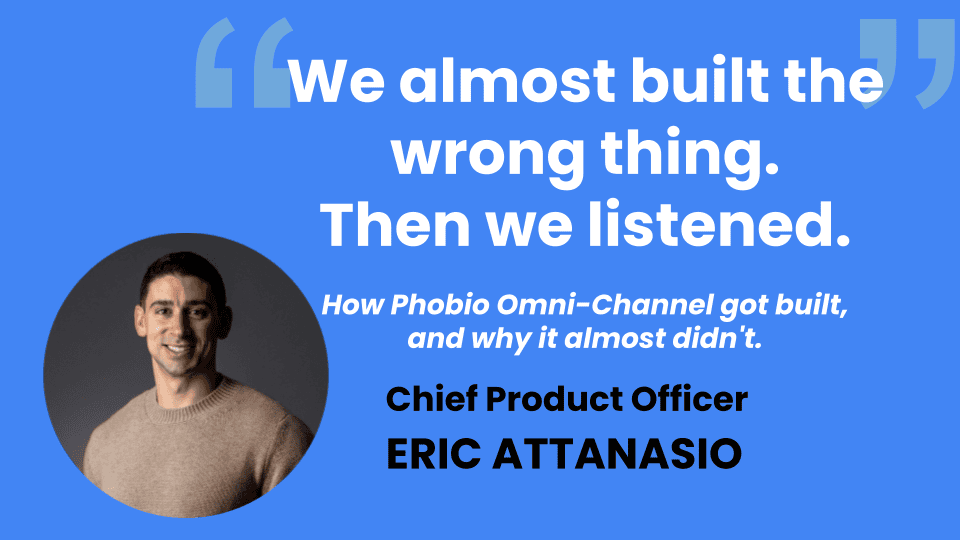
How Phobio Omni-Channel got built, and why it almost didn’t.
By Eric Attanasio, Chief Product Officer, Phobio
Why we pulled the feature
In the second half of 2025, omni-channel trade-in was on my product roadmap. Then I removed it.
I don’t think it was a bad idea, but I couldn’t answer two basic questions: what problem does this solve, and for whom? I had a strong instinct that the two biggest environments where trade-in lives, online shopping and in-store purchasing journeys, should be connected. eCommerce has been moving in that direction for years. Buy online, pick up in-store has grown into a strong channel for many retailers. Retailers have spent a decade connecting the online purchasing journey with the in-store experience. Trade-in felt like an obvious candidate for the same treatment.
But feeling like something should exist and knowing that it solves a real problem are two different things. I’d seen enough features launched on instinct alone to know how that ends. So we pulled it, and I told myself I’d only bring it back if the market told me to.
How we listened
Early 2026, I made it a priority to sit down with retail partners in structured discovery conversations. A few rules I had for these conversations were 1. No presentations and 2. No questions that were structured to inform our partner what I wanted to hear. I wanted to hear them talk. The format was intentionally open, where we discussed what challenges do you face operationally, how does trade-in work today, where do your reps struggle, why do customers walk away without completing a trade. Brainstorming when it felt natural, but mostly just listening.
This kind of conversation is harder to run than it sounds. The temptation when you have a product idea is to steer, and I was conscious of that.
What came back was consistent across every partner we spoke with. Line management during peak periods is a serious operational problem. Holiday seasons and promotional windows make it worse. And trade-in sits at the center of it because of one specific issue: customers arrive at the store without their device prepared to hand over. Their device isn’t backed up, and their accounts are still logged in. The rep can’t move forward, and the customer waits 30 to 60 minutes trying to back up a device on unreliable in-store wifi. This causes longer lines and more disengaged customers. A result of all of this is that trades get abandoned and the rep’s time is consumed by something that has nothing to do with selling.
They all described the same thing: a throughput and preparation problem rooted in how retail operations actually run. Trade-in friction is an operational issue. Solving that problem requires understanding the store environment..
What we built
Phobio Omni-Channel moves the slow part of the trade-in process out of the store entirely.
A customer starts their trade-in online through a branded experience before they ever leave home. They select their device, complete a condition assessment, and receive a reservation code along with clear instructions for backing up their device and signing out of their accounts. By the time they walk into the store, the preparation is done. The rep pulls up the reservation by code or phone number, picks up mid-process, and completes the transaction in a fraction of the usual time.
The line keeps moving, the rep stays focused on the sale, and more trades complete during the periods when it matters most.
What happened when we went back
After we built it, we went back to every partner who had informed it and walked them through what we’d made. That step is not standard practice in this industry, and I think it should be.
What we heard back was meaningful. Partners could see their own feedback reflected in the product. They weren’t being shown a generic solution and asked to fit it into their operation. They were seeing a specific response to a specific conversation. That approach builds a different kind of trust than a good demo. Several of those conversations have already led to deeper engagement and refinements that have improved the product.
There’s also something worth saying about what it signals to a partner when you come back. It tells them the conversation wasn’t performative and that the listening was real.
Where we’re taking this
Omni-channel is one piece of something larger we’re doing at Phobio this year. We are running the same discovery process across all of our partner segments. With our business channel partners, we’re digging into how they use our platform day-to-day, where it falls short, and where we can think big about where it can go. With our online trade-in partners, we’re looking closely at where customers lose trust or drop out of the experience before completing a trade.
The pattern is the same regardless of channel. We’re having open conversations, listening to our partners, and identifying problems to be solved. Then we build.
This is not a new philosophy for us. Phobio has always been close to the environments where trade-in actually happens. What’s new is the intention and structure we’re bringing to it, making it systematic rather than occasional and treating partner insight as a product input.
The goal is straightforward: faster transactions, more completed trades, less friction during the periods when retail margins are won or lost. Products built from reality instead of assumptions. That’s what listening is actually for.
If you’re a retailer navigating these challenges and want to see what Phobio Omni-Channel looks like in practice, I’d welcome the conversation.